
One day full of inspiring keynotes and new connections at the premier AI summit for product development.

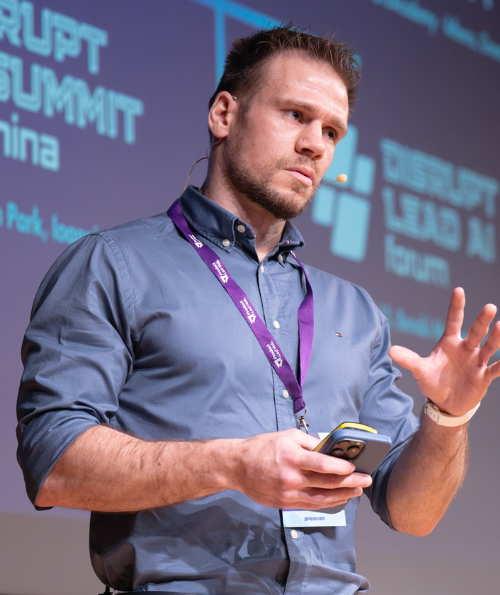
Step into the future of product management with an Iron Man twist. This session explores how innovative tools supercharge product teams worldwide, sharing the agentic AI workflows used to drive efficiency, spark creativity and generate game-changing value. Like Tony Stark's transformation, you'll discover how to harness AI to revolutionize your PM approach — walking away with the mindset and tools to lead with the power of AI, whether refining your innovation process or scaling development.

AI isn't a futuristic concept — it's here, reshaping how businesses operate. This session goes behind the scenes of AI in finance with real-world lessons from XM: from revolutionizing client engagement with AI-powered chatbots to optimizing customer experience. It tackles the challenges of deploying AI at scale — managing hallucinations and balancing cost, speed and accuracy — and the strategic trade-offs that will define the future of financial services.

As AI agents evolve, their true power lies not in generalization but in verticalization — tailoring AI to deeply understand and transform industry-specific workflows. Drawing on work in AI-driven therapy for speech & language disorders (Ogma) and AI-powered insurance claims automation (InsureAI), this session shows how specialized agents enhance efficiency, accessibility and scalability, and offers a framework for building and deploying vertical AI agents — where AI's next frontier is not just intelligence, but specialization.

Online betting is a steeply growing form of digital entertainment in Greece, with thousands of users navigating a wide variety of products. Their data sets trace customer journeys and preferences — and the explosion of data volume puts machine learning in pole position for fast, relevant, proactive insight. With real business examples, this session shows how Segmentation Models drive product and promotion relevance, Propensity Models speed up proactive CRM, and Forecasting Models optimize the marketing investment mix — and how ML has become a day-to-day reality at OPAP.

As development accelerates in the age of AI, traditional approaches to code governance struggle to keep up. With everything now expressed as code, organizations face growing complexity, fragmentation and risk — and manual controls no longer scale. This session advocates a robust, embedded governance model that fits how modern teams build and ship: supporting fast, secure, reliable delivery built into workflows from the start, not bolted on after the fact.

An introduction to a new intensive, project-based course designed to fast-track your journey into Generative AI. Tailored for engineers, technical product leaders and AI practitioners, it blends essential theory with hands-on experience — focusing on Retrieval-Augmented Generation (RAG) and Knowledge-Augmented Generation (KAG) as core capabilities for AI-native products. You'll see how the course is structured and, crucially, how each student walks away with a fully functional, personalized GenAI prototype ready to expand, iterate or deploy.

An introduction to a comprehensive training program built to equip professionals with the skills and mindset to lead AI-driven product development. As AI reshapes industries, the ability to bridge technical capability with business strategy has never been more critical. The course offers a structured, end-to-end journey through the key pillars of AI Product Management — from foundational AI concepts and development workflows to strategic planning, success metrics and ethical considerations — for product managers, aspiring AI leads and business professionals.
Great product management isn't just reacting to feedback — it's anticipating needs before they're voiced. As AI capabilities accelerate, the PM role evolves into one blending intuition, experimentation and technical fluency. A practical deep dive into leading AI-driven product development in 2025: a walkthrough of the AI product lifecycle from idea to implementation, techniques for integrating AI into discovery and validation, strategies for balancing innovation with usability, and the tools and mindsets PMs need in fast-moving, high-uncertainty environments. (Part I)
The second half of the deep dive: hands-on continuation of the AI product lifecycle, running experiments, validating solutions and putting the discovery-to-delivery techniques into practice — so you can build intelligent products users love and trust, and lead from a step ahead. (Part II)
How Engel & Völkers — a global real estate brokerage operating in 35 markets — faces the challenge of modernizing a large, distributed organization: driving digital transformation across legacy platforms while introducing AI-powered tools to enhance customer satisfaction and organizational efficiency. Real-world learnings on aligning global product strategy, navigating change management, and delivering measurable value at scale.


AI is rewriting the rules of product analytics — turning chaos into clarity. This session explores how AI automates data workflows, ensures trusted insights through smart observability, and unlocks access for everyone via natural language. The result: faster decisions, deeper personalization, and product growth driven by intelligence rather than guesswork.

Despite significant investment, 90% of AI models never reach production — because AI isn't a product until you deliberately shape it into one. Too often, initiatives begin as technical experiments disconnected from business goals. This interactive session, with real-world case studies from gaming and beyond, lays out a proven approach: tackling ambiguous AI requests, using data-driven insights to identify meaningful problems, defining and tracking AI success metrics that matter, and aligning AI features with broader product and business objectives.

As AI capabilities evolve, many companies are rethinking how to scale internal operations without overburdening their teams. This session shares how Intelligencia AI approached the challenge within clinical data curation — harmonizing more than 1.5 billion data points daily — by designing tools that support and extend their Clinical Data Experts rather than replace them. Covers build vs. don't-build decisions, product–research collaboration, where LLMs added value or fell short, and maintaining team wellbeing amid scaling demands.

The AI boom has unleashed a torrent of possibilities, but turning models and demos into real, user-trusted solutions remains an uphill battle — especially for organizations not born AI-first. This session cuts through the noise with hard-won lessons on shifting mindsets, choosing the right problems, and steering clear of the traps that derail AI product development. Topics include the AI mindset shift for non-AI-native companies, choosing the right problems when tech outpaces needs, and avoiding common pitfalls on the road to product-market fit.
