// Presented by Product-Led Hub · A Byproduct of Disrupt AI Summit Series
The State ofGen AI Leadership2025-26 Volume I
A 175-KPI benchmark of enterprise AI adoption & readiness
The State of Gen AI Leadership 2025-26 (Volume I) is Product-Led Hub’s KPI-backed read on enterprise AI — 175 metrics from 17 sessions and 50 leaders at the Gen AI Leadership Forum in Athens, as seen on our stage. The KPIs in this first volume are drawn from 2025 for now; later volumes carry the index forward. It maps the gap between enterprise AI adoption and real enterprise AI readiness — only 1 in 5 organisations are genuinely AI-ready — and the shift toward the State of Agentic AI, cross-checked against independent global research.
// The only KPI-backed view of how enterprises are moving from AI adoption to real AI readiness — and toward the agentic frontier.
175
KPIs
50
Speakers
300+
Companies
500+
Attendees
At a glance
Overall AI readiness score
1.61 / 5
A third of the way to ready
On a 0–5 scale of how ready businesses are to scale AI for real, the enterprise scores just 1.61 — about a third of the way there. Most of the groundwork is still missing.
Adoption & Usage
9.5%
Only 9.5% of Greek businesses actually use AI
Barely a third of the US rate (~30%). The market is early — and the impressive adoption figures usually quoted are US/Western benchmarks, not local reality.
Business Impact & ROI
15%
The payoff, where AI is used well
Early adopters report meaningful gains — up to 21% better decisions, 15% higher productivity, ~2 hours freed per employee.
The finding, in one line
Where AI transformation is going
Two-thirds of companies’ AI effort goes into just two things — putting AI to work in real use-cases, and proving it pays off. Almost nothing goes into the harder groundwork: strategy, wider adoption, and next-generation ‘agentic’ AI. It shows in the results — where AI is actually deployed it delivers, yet only about 1 in 5 organisations has the data, skills and governance to scale it past a pilot. The effort is racing ahead of the foundations — and that gap decides who turns early wins into lasting change. Throughout, that readiness is scored 0–5 across eight pillars — the AI Delta Maturity Framework™ — so ‘ready’ always means the same thing.
// From the founder
Editor’s Note
Five years ago, “AI strategy” was a slide in a board deck. Today it’s the operating system of the business — or it should be.
We watched that shift happen in real time. In November 2023, we opened the first AI Summit at the Athens Conservatoire — a room testing whether Greek business leaders wanted a serious conversation about applied AI. They did.
Five years and 12 summits later, the Disrupt (AI) Summit Series has put 200+ speakers in front of 4,000+ attendees across 700+ companies — from that first cautious gathering to a full calendar spanning Athens, Ioannina, and every function from engineering to the boardroom. We’ve watched the conversation move from “what is Gen AI” to agentic systems that plan, act and close the loop on their own.
That’s five years of signal — the kind that usually lives and dies in a conference room, in a slide someone photographed and never opened again.
This year we decided not to let it disappear. We’ve sat through enough AI pitches to know how much of this space runs on opinion — so we didn’t ask the room what it believed. We logged what it measured.
Every figure a leader stated on stage or showed on a slide at the Gen AI Leadership Forum 2025 edition, captured and cross-checked against IBM, McKinsey, Gartner, WEF and Eurostat. Not our take. Not a vendor’s roadmap. Fifty leaders, on our stage, and the numbers they actually stood behind.
This is Volume I of this report. It’s not the final word — it’s the first entry in an index we’ll keep building, Forum by Forum, to track how organisations actually move from adopting AI to running it autonomously.
Read it before your next board meeting. Then come close the loop live at the 2nd Gen AI Leadership Forum, October 21–22, at OTEAcademy, Athens.
What this report is.The State of Gen AI Leadership 2025-26 (Volume I) is original research by Product-Led Hub, drawn from the Gen AI Leadership Forum 2025 — 175 KPI metrics leaders stated on stage or showed on slides across 17 sessions, turned into an evidence-based view of how enterprises move from AI adoption to real AI readiness.
Part of a bigger picture. This is Volume I — its KPIs and results reflect 2025 for now — one edition in an ongoing series across Leadership, Engineering and Product — that compile into The State of Agentic AI (2023–2026), Product-Led Hub’s evolving, KPI-backed index of how organisations move from adoption to execution. Each edition adds a lens; together they build the full picture.
Why it was crafted. Most talk about “AI leadership” runs on opinion, vendor decks or borrowed forecasts. We built this to replace that with evidence — a hard baseline of what leaders in the room actually measure, so any organisation can benchmark itself honestly and see the real distance between adoption and execution.
How it was built. Every figure was coded by hand from the sessions and cross-checked against independent global research — not surveyed opinion or resold analyst forecasts. (Full method in the Methodology section.)
// Who leads this research
About Product-Led Hub
Product-Led Hub (PLH) is a product and AI education and events company based in Athens, Greece. Founded in 2019, PLH designs and delivers certification programs and corporate AI upskilling engagements for professionals and organizations, produces industry summits across Greece, and cultivates a professional community connecting product and AI practitioners, leaders, and organizations across the region.
This report is drawn from one of those events — the Gen AI Leadership Forum 2025. PLH doesn't survey opinion or resell analyst forecasts; it works from primary, practitioner-led signal. Across a series that now runs to 12 summits · 150+ talks · 200+ speakers · 4,000+ attendees, every figure is coded by hand. The same teams PLH trains and convenes are the ones whose work this report measures — which is why PLH can read the move from prompting to autonomy from the inside.
// Practitioner-led
Every speaker has shipped
The stage is reserved for people who have built and run real AI systems in production — not analysts or vendors pitching a roadmap.
// Execution over theory
Production results, not demos
PLH measures what reached production: maturity, governance, cost and failure modes are reported, not hidden behind a highlight reel.
About the Disrupt AI Summit Series
Since 2023, the Disrupt (AI) Summit Series has grown into a series of events addressing the challenges and opportunities that senior AI and technology leaders encounter across diverse business sectors. The 2026–2027 season marks its 5th anniversary — a milestone reflecting five years of bringing together global technology leaders. Beyond exploring what Gen AI makes possible across fields, each event delivers a comprehensive view of AI's role in tech and product teams — culminating in a focus on how leadership itself is reshaped by these advancements.
Featuring in-person technical workshops, engaging sessions, interactive roundtables, live product demonstrations, detailed case studies, and discussions with industry peers and international thought leaders, the Disrupt Summit Series is the premier destination for AI innovation.
About the Gen AI Leadership Forum
Where leadership meets the intelligence economy. We are entering a new paradigm where competitive advantage is no longer defined by access to AI — but by the ability to execute with it at scale. This is the shift from adoption to execution. From isolated use cases to system-wide intelligence. From pilots to production. From potential to measurable impact.
AI is no longer a distant frontier — it is the operational core of modern organisations of every scale. Today’s challenge is no longer understanding AI; it’s embedding it into the fabric of decision-making, systems, and execution. The Gen AI Leadership Forum sits exactly at this inflection point — where executive leadership, founders, operators, and investors meet the operational reality of GenAI-driven transformation.
AI leadership will not be defined by technology alone, but by how organisations of every size redesign themselves around it — structurally, operationally, and strategically.
First, the shift in one line
Generative AI — responds
Give it a prompt, it returns an output — text, an analysis, code. Powerful, but it waits for instructions and stops at the answer.
Agentic AI — acts
Give it a goal. It plans, uses tools, takes actions and adjusts — looping until the job is done. Value moves from a good answer to a completed task.
The Forum caught this shift in motion. In its 'Gen AI vs Agentic AI' sessions, teams were running 2–5 agents today, with speakers projecting 100–1,000 within a year — and a 2026 goal (set at the Forum) of at least one AI agent per development team.
How to read this report
Headline Findings — The nine headline reads that stand out across the 175 figures — start here for the punchline.
Methodology & Validation — How we captured, classified and checked the figures, and the 10 headline numbers cross-checked against named external sources.
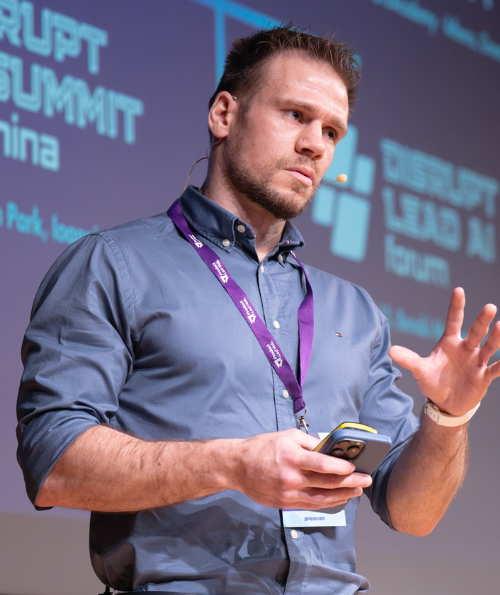
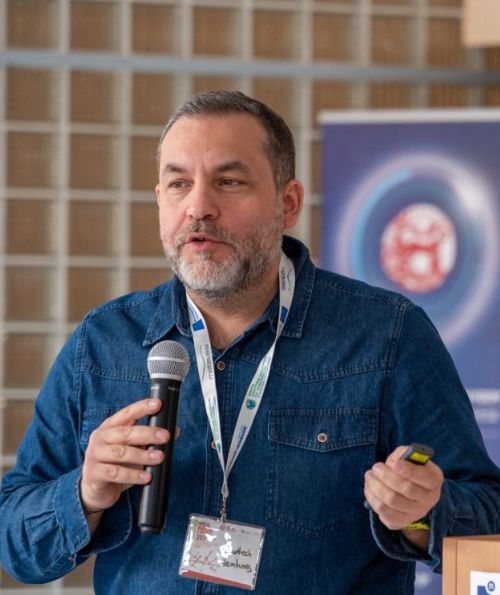
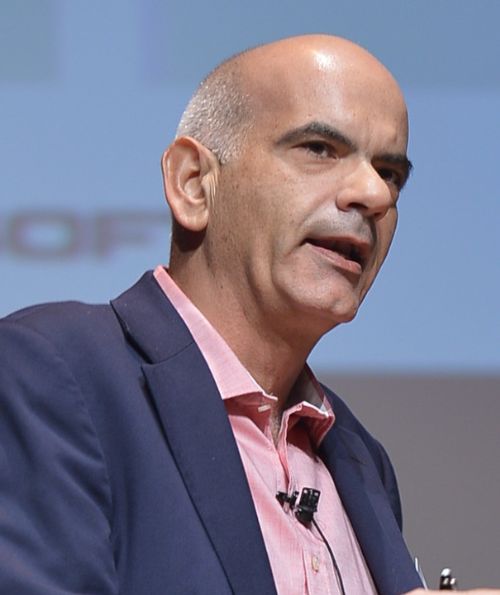
Who Attends & Speakers — Who was in the room (500+ attendees) and on the stage (50 leaders).
Data Analysis — The 175-metric dataset by 6 agenda themes, 14 KPI types and 4 evidence types.
By Pillar & AI Delta Maturity — The eight readiness pillars scored 0–5 (the AI Delta Maturity Framework™), then the same evidence read across the six agenda themes.
By Audience — The same data read through six audience lenses.
The State of Agentic AI — The frontier the series tracks — least-proven, thinnest-measured (just 7 of 175 metrics).
Conclusions, Outlook & Recommendations — Where the data points to 2030, and what to do about it.
Before you ask
Is this just local data?
The Forum is a single Athens event with a largely Greek enterprise audience, but every headline is cross-checked against global research (IBM, McKinsey, WEF, Eurostat, Gartner).
Why trust the numbers?
All 175 KPI metrics are extracted verbatim from timestamped session transcripts; 10 were cross-checked against named external sources.
Measured or cited?
Some figures are speaker-cited, anecdotal or illustrative — preserved with their original framing.
Are the 2026–2030 figures yours?
No. The coded data ends in 2025. Forward figures are external forecasts (Gartner, WEF) placed next to the Forum's trajectory — directional, not PLH measurements.
The single biggest finding?
The readiness gap: 60–70% of organisations run AI in at least one unit, but only 1 in 5 are genuinely AI-ready to scale.
What share of enterprises have adopted AI?
Around 60–70% of organisations now run AI in at least one business unit — but broad, enterprise-wide AI adoption is far rarer.
How AI-ready are enterprises?
Only about 1 in 5 are genuinely ready to scale AI — the enterprise AI readiness gap between running AI and being ready to run it at scale.
Is enterprise AI delivering ROI?
Where it’s applied well, early adopters report meaningful returns — up to 21% better decisions, ~15% higher productivity and roughly 2 hours freed per employee.
A unified profile of every attendee across all 17 sessions — seniority, function, company size and industry.
500+
Unique attendees
Gen AI Leadership Forum 2025
300+
Attendee companies
distinct organisations
41.7%
C-Level / Founder
top of the org chart
74.9%
Senior / decision-maker
C-Level + Management
Seniority of the room
C-Level / Founder41.7%
Management (VP/Director/Head + Manager/Lead)33.2%
Mid-Level20.3%
Senior (IC specialist)4.8%
Three in four people in the room (74.9%) were C-level or senior management — this was an audience of decision-makers, not practitioners.
Professional domain
Engineering38.8%
Other (HR/Marketing/Consulting/Sales/Design/Ops/Finance/Research)21.8%
Data / AI15.2%
Leadership / GM14.3%
Product9.9%
Engineering was the single largest function (38.8%), but a broad non-technical tail — leadership, product, data, and a mix of HR, marketing, sales and operations — shows AI being treated as a cross-functional agenda, not just an IT project.
Company size
1–102.4%
11–5010.9%
51–20021.4%
201–50015.1%
501–1,00010%
1,001–5,00013.9%
5,001–10,00015.3%
10,001+11%
The overwhelming majority came from mid-sized and large organisations, where the gap between adopting AI and being ready to scale it carries the most operational weight.
Industry
Software / IT38.8%
Finance / Fintech9.2%
Industry / Energy9.1%
Retail / E-commerce7.5%
Telecom7.1%
Gaming6.4%
Education / Research6.2%
Media / Marketing5.6%
IT Services / Consulting5.5%
Healthcare / Pharma4.6%
Software and IT led at 38.8%, but finance, industry/energy and a long tail of other sectors made this a cross-industry conversation rather than a tech-only one.
The line-up skewed senior and hands-on: founders, C-level leaders and engineering heads set the tone, with more than a quarter representing companies headquartered outside Greece.
The reads that hold across all 175 KPI metrics. Each finding sets what our AI Delta Maturity analysis measures against what the wider industry shows — then states plainly what the two establish together.
The verdict
The Analysis
Enterprise AI readiness stands at just 1.61 out of 5.
Across eight readiness pillars, the field is barely a third of the way to ready — an AI Delta of 3.4 still to close.
The Industry
Global AI investment will exceed $300–400B in 2025, up from $235B and growing 10× faster than the economy.
The Takeaway
The money is racing far ahead of the readiness. Capital is being committed faster than organisations can absorb it — the spend is real; the capacity to convert it into scaled value is not.
External check — agreesMIT finds 95% of enterprise GenAI investment yields no measurable return, and Deloitte flags the same rising-spend, elusive-returns paradox. MIT / Forbes → · Deloitte →
The foundation
The Analysis
Three readiness pillars score an outright zero.
Strategy & Leadership, Data & Infrastructure and Innovation Velocity carry no measured evidence of readiness whatsoever.
The Industry
Microsoft, Google and AWS are ordering hundreds of thousands of next-generation GPUs.
The Takeaway
The industry is stockpiling compute at scale — yet the strategy, data foundations and forward-capability to use it do not exist. This is hardware with no ground to run on.
External check — agreesMcKinsey names data quality the #1 barrier to scaling AI; Gartner warns most organisations lack AI-ready data. McKinsey → · Gartner →
The imbalance
The Analysis
Execution has outrun the foundation beneath it.
The single strong pillar — Use Case Deployment at 4.17/5 — rests on a data-and-infrastructure base scoring 0.00.
The Industry
The cost of inaction is severe: offshore downtime runs $500K an hour, equipment failure $200–500K a day.
The Takeaway
The pressure to deploy is undeniable, so organisations push AI live regardless — on a base that cannot hold it. Deployment sprints ahead; the foundation is left behind.
External check — agreesMcKinsey: adoption is near-universal but only about a third have scaled; MIT: 95% of pilots stall on a weak base. McKinsey → · MIT / Forbes →
The bright spot
The Analysis
Where AI is deployed, it delivers — the lone proven strength.
Use Case Deployment (4.17) dwarfs every other pillar (next best 2.50): 50+ live applications, −40% downtime, −30% scrap, +20% customer satisfaction.
The Industry
The prize is quantified — a quarter of working hours are lost to repetitive tasks; 15% of legal spend is avoidable.
The Takeaway
The returns are proven and measured, not speculative. The value is on the table for any organisation able to deploy and scale it properly.
External check — agreesMcKinsey reports 10–20% function-level cost cuts where AI is deployed; Deloitte finds 74% of top initiatives meet or beat ROI (20% above 30%). McKinsey → · Deloitte →
Partial progress
The Analysis
The remaining pillars are partial — moving, not mature.
Adoption, Business Impact and Governance sit at 2.0–2.5, with Talent just below at 1.67 — genuine progress in each, held back by equally real gaps.
The Industry
Training is scaling — but real in-house capacity is concentrated in a few enterprise giants, not the market.
The Takeaway
Activity keeps rising, but volume is not becoming capability. These pillars are heading the right way — they have not matured.
External check — agreesWEF: training completion is rising (41%→50%) but a 39% skills gap persists; Korn Ferry projects 85M roles unfilled for lack of skills. WEF → · Korn Ferry →
The gap
The Analysis
Adoption has decisively outrun readiness.
60–70% of organisations run AI live in at least one unit; only 1 in 5 are genuinely ready to scale — a 40-to-50-point gap, and the dataset’s most consistent structural finding.
The Industry
AI keeps getting cheaper — inference costs half of last year’s, entry pricing near $20 a month.
The Takeaway
Falling costs make switching AI on easy and cheap. Being ready to scale it is a harder, different thing — and four in five organisations are not there.
External check — agreesMcKinsey: ~88% use AI, only ~6% see enterprise-wide impact; MIT: 95% of pilots show no P&L impact. McKinsey → · MIT / Forbes →
Attention is not readiness
The Analysis
The loudest signals are not the weakest pillars.
The most-measured theme and the noisiest topics are not where readiness is lowest. Attention and readiness are not the same measure.
The Industry
Capital is everywhere — VC funds multiplying, the EU pledging €200B for AI.
The Takeaway
The volume of money and coverage is easily mistaken for progress. It is not readiness — and it usually points away from where the real gaps sit.
External check — agreesMIT’s ‘GenAI Divide’ — high adoption, low transformation; McKinsey: widespread use, rare real impact. Noise isn’t readiness. MIT / Forbes → · McKinsey →
The loud worry
The Analysis
Governance is the loudest worry — but mid-tier, not last.
It scores 2.50/5. The true zeros are strategy, data and forward-capability — not governance.
The Industry
The threat is real: the average breach costs $4.44M and cyberattacks rose 44% in a single year.
The Takeaway
Governance dominates the room because the threat behind it is real and expensive. But loudness is anxiety, not the lowest score — the quiet gaps are the deeper ones.
External check — agreesIBM: 63% of organisations have no AI-governance policy; Gartner expects 40% of CIOs to demand ‘guardian agents’ by 2028. IBM → · Gartner →
A caveat
The Analysis
Every win is a single, well-scoped deployment.
The strong results are real but pilot-level — none is yet proven enterprise-wide.
The Industry
Many of the boldest figures are explicitly illustrative — benchmarks stated as goals, not results achieved.
The Takeaway
The wins are genuine and repeatable at pilot scale. The leap to enterprise-wide, proven-at-scale results has not been made.
External check — agreesMIT: only 5% of pilots reach real scale; McKinsey: only about a third have scaled AI enterprise-wide. MIT / Forbes → · McKinsey →
The basis — how we know
Methodology
This report is original research by Product-Led Hub — a KPI-backed evidence base on the state of AI leadership across the enterprise. This is Volume I; the figures here are drawn from 2025. Every number in it is a specific figure a leader stated on stage or showed on a slide during the Forum, captured and checked by our research team, never estimated or averaged. In total we recorded 175 such figures across 17 sessions over two days. Here is how we built and checked that dataset, so you can see exactly how much weight each figure carries.
How we built the dataset
Our research draws on the recorded sessions and the speakers' own presentations. Each figure was taken word-for-word from a timestamped recording or the slide it appeared on — nothing rounded, inferred or filled in.
We logged 175 figures in total, drawn from 17 sessions.
Every figure was classified under one of the 6 agenda themes and one of 14 KPI types, so no number is ever counted twice.
How we checked the numbers
We didn't stop at recording what was said. Key figures were cross-checked against published research from named outside organisations — IBM, McKinsey, Eurostat, the World Economic Forum and Gartner among them — looked up live as this report was written, to confirm the Forum's numbers held up against global benchmarks.
The AI Delta Maturity scores
The report reads the same 175 figures two ways, and it helps to keep them apart:
By attention — how many figures a topic drew (e.g. Governance = 30 of 175). This shows where the room's focus went.
By readiness — the AI Delta Maturity view regroups the evidence into eight readiness pillars and scores each 0–5. Here we count distinct signals: how many different voices back a point, not how many numbers repeat — so one speaker's ten figures count once. That's why Governance shows as 30 figures in the dataset but rests on 4 distinct scored KPIs — the two answer different questions, they don't disagree.
Each pillar's score is the share of its readiness KPIs that are positive: score = ready ÷ (ready + gap) × 5. The distance to a full 5 is the pillar's AI Delta (Δ). Only KPIs that measure the field itself are scored — of the 175 KPIs, 22% are readiness-relevant (ahead or short), which dedupe to the distinct scored KPIs the pillars are scored on; the other 78% are vendor product results or market/investment backdrop, shown alongside but never scored. A pillar is flagged thin when it rests on no corroborated Ready or Gap evidence — the same rule the AI Delta Maturity Framework™ applies, and why the three zero-scoring pillars read as zero.
How the eight pillars were derived
We didn’t invent these eight readiness pillars. They adapt the AI-maturity models the industry already uses — Gartner, McKinsey, Sema4.ai, Straive and Nemko — organised into eight capabilities after the pattern of Nemko’s AI-CMM: strategy · talent · data & infrastructure · deployment · adoption · business impact · governance · innovation velocity. Two of the eight — Adoption & Usage Depth and Innovation Velocity — are PLH’s own synthesis and the thinnest-sourced externally, as the framework notes.
Research & authorship
The State of Gen AI Leadership 2025-26 (Volume I) is original research by Product-Led Hub, researched, hand-coded and written by Despina Exadaktylou — Founder & Managing Director, Product-Led Hub. Every KPI was captured from the sessions of the Gen AI Leadership Forum 2025 and cross-checked against named external sources (IBM, McKinsey, WEF, Eurostat, Gartner).
Attribution guidelines
You’re welcome to reference, quote and share these findings — with attribution to Product-Led Hub and a link back to this report. Please don’t republish the full report, datasets or charts without written permission.
Suggested citation
Product-Led Hub (2025). The State of Gen AI Leadership 2025-26 (Volume I). productledhub.com/state-of-gen-ai-leadership-2026
The 175 KPI metrics, first counted two ways — across the six agenda themes and the fourteen KPI types — then each opened up into what was actually measured.
Overview
By agenda theme (% of 175 KPIs)
Integrating AI into Core Systems33%
ROI-Driven AI21%
Ethical AI & Governance17%
Hiring & Upskilling15%
Reshaping Strategic Leadership9%
Gen AI vs Agentic AI5%
By KPI type (% of 175 KPIs)
Transformation25%
Adoption14%
Investment & Funding10%
Risk, Security & Governance8%
Company & Platform Scale7%
Talent & Workforce7%
Market & Regulatory Context6%
Operational Baseline / Problem5%
Agentic4%
Technical & Infrastructure Scale4%
Sentiment & Trust3%
Deployment & Readiness3%
ROI & Cost/Pricing3%
AI Quality/Accuracy Standards1%
Two themes — integrating AI and chasing ROI — draw more than half the numbers, while strategy and the agentic frontier barely register. And one measurement type, Transformation, is a quarter of everything measured.
By evidence type
Every KPI is also read as one of four kinds of evidence — the cut that decides what actually feeds the readiness score.
Market & industry context61%
Supplier capability (vendor)17%
Ready — scores readiness12%
Gap — scores readiness10%
The most important cut: only 22% of the dataset (Ready + Gap) actually measures whether the field is ready. The other 78% is what suppliers can do and what the market is spending — kept as backdrop, never scored. This is why a loud topic can still hide a thin foundation.
By agenda theme
Each theme (classified by topic) opened up by the KPI types inside it.
Ethical AI & Governance · 17%
Risk, Security & Governance6%
Market & Regulatory Context3%
Adoption2%
Company & Platform Scale2%
Transformation2%
AI Quality/Accuracy Standards1%
Integrating AI into Core Systems · 33%
Transformation12%
Adoption7%
Operational Baseline / Problem Context4%
Technical & Infrastructure Scale4%
Deployment & Readiness3%
Company & Platform Scale2%
Market & Regulatory Context1%
Talent & Workforce1%
ROI-Driven AI · 21%
Investment & Funding10%
Transformation6%
ROI & Cost/Pricing3%
Company & Platform Scale1%
Market & Regulatory Context1%
Operational Baseline / Problem Context1%
Hiring & Upskilling · 15%
Talent & Workforce6%
Sentiment & Trust3%
Transformation3%
Company & Platform Scale2%
Reshaping Strategic Leadership · 9%
Adoption5%
Market & Regulatory Context2%
Transformation2%
Risk, Security & Governance1%
Gen AI vs Agentic AI · 5%
Agentic4%
Adoption1%
Risk, Security & Governance1%
By KPI type
Each type's metrics grouped by what they actually measure — read from the descriptions. The two broadest are charted; the rest are condensed.
Definition · an original Product-Led Hub framework
The AI Delta (Δ) is the measurable gap between where an organisation’s AI capability is today and where it needs to be to scale.
The AI Delta Maturity FrameworkTM is Product-Led Hub’s original model for measuring how ready an organisation is to scale AI. It scores eight readiness pillars — strategy, talent, data & infrastructure, use-case deployment, adoption, business impact, governance, and innovation velocity — each 0 to 5, on the weight of evidence that the capability is genuinely in place. The distance from a pillar’s score to a full 5 is its AI Delta (Δ) ; averaged across the eight, it gives a single readiness score and an overall Delta. Any organisation can run it on its own evidence. It synthesises and extends established maturity-model thinking into an original, evidence-weighted method.
Pillar score (0–5)Ready ÷ (Ready + Gap) × 5
AI Delta (Δ)5 − pillar score
Overall readinessmean of the 8 pillar scores → 1.61 / 5
Ready = corroborated evidence the capability is in place; Gap = corroborated evidence it is missing. Both count distinct scored KPIs, not repeats or one-off claims. A pillar with no Ready or Gap evidence is flagged thin.
Applied in this report: we run the framework on the Gen AI Leadership Forum as a worked example — its agenda and 175 datapoints are the evidence base. Each datapoint is read as Ready or Gap (which score), or as Vendor or Context (kept alongside as industry backdrop, not scored). The agenda is simply the example — the framework itself is agenda-independent.
The readiness funnel
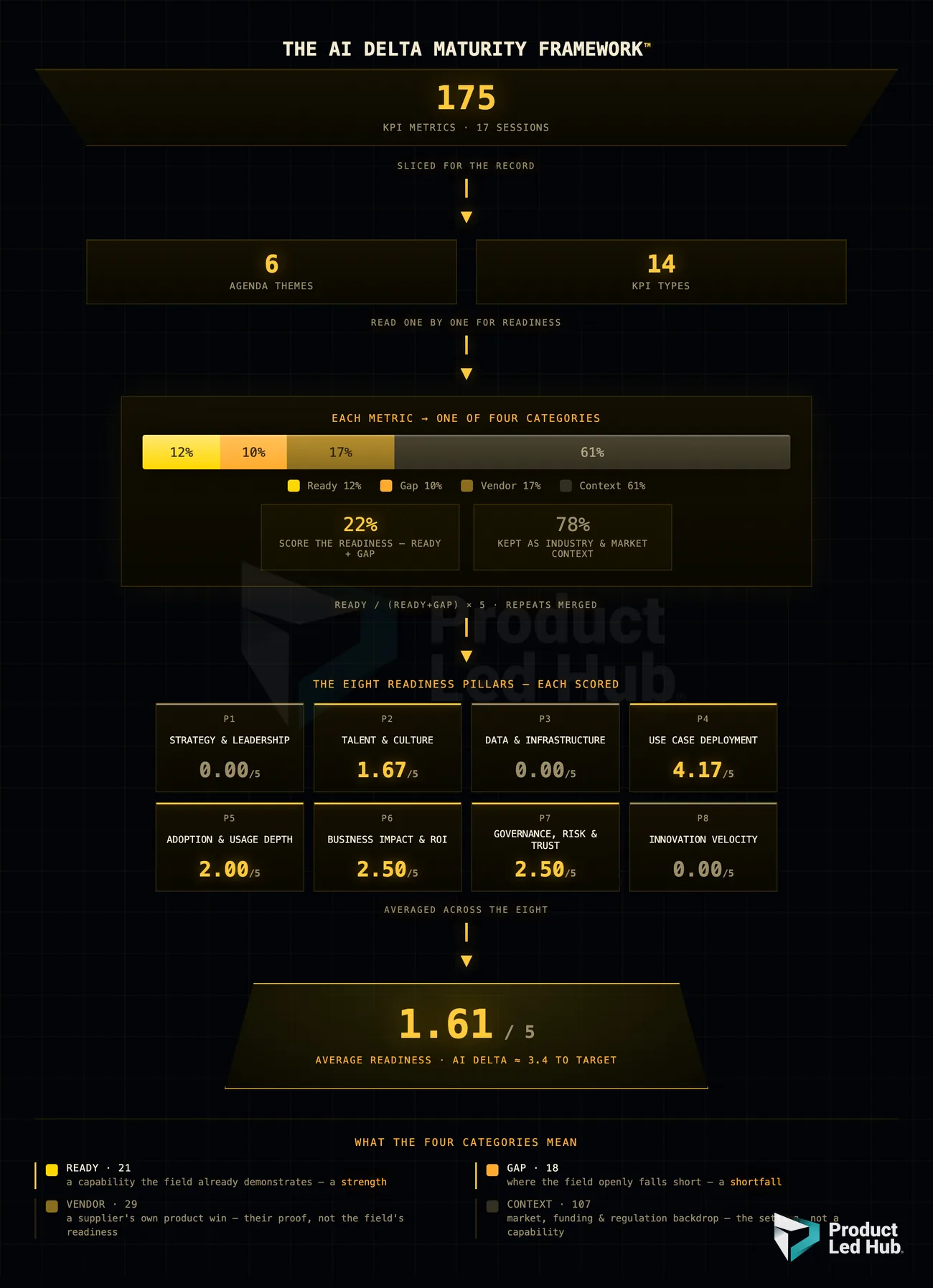
How a single readiness score is built from the raw evidence — in the open. Every one of the 175 metrics is first sliced for the record, then read one by one; only the KPIs that measure the field’s own readiness feed the score, and each step is shown so nothing is taken on trust.
The AI Delta Maturity FrameworkTM
175
KPI metrics · 17 sessions
sliced for the record▼
6
agenda themes
14
KPI types
read one by one for readiness▼
each metric → one of four categories
12%10%17%61%
Ready 12% Gap 10% Vendor 17% Context 61%
22%score the readiness — ready + gap
78%kept as industry & market context
ready / (ready+gap) × 5 · repeats merged▼
the eight readiness pillars — each scored
P1
Strategy & Leadership
0.00/5
P2
Talent & Culture
1.67/5
P3
Data & Infrastructure
0.00/5
P4
Use Case Deployment
4.17/5
P5
Adoption & Usage Depth
2.00/5
P6
Business Impact & ROI
2.50/5
P7
Governance, Risk & Trust
2.50/5
P8
Innovation Velocity
0.00/5
averaged across the eight▼
1.61 / 5
average readiness · AI Delta ≈ 3.4 to target
What the four categories mean
Ready · 21a capability the field already demonstrates — a strength
Gap · 18where the field openly falls short — a shortfall
Vendor · 29a supplier's own product win — their proof, not the field's readiness
Context · 107market, funding & regulation backdrop — the setting, not a capability
The Forum's six agenda themes — Strategic Leadership, Hiring & Upskilling, Integrating AI into Core Systems, ROI-Driven AI, Gen AI vs Agentic, and Ethical AI & Governance — regroup into eight readiness pillars: the same 175 metrics, re-read as a maturity model.
Under each pillar's score: where the field is ahead, where it falls short, and the market momentum around it. This is a different lens from the headline “~20% AI-ready”: that figure counts how many organisations are ready; the maturity score weighs how strong the evidence of readiness is across all eight pillars — two views of the same gap, not competing numbers.
Pillar 1 of 8 · How ready is leadership for AI?
Strategy & Leadership
Related forum theme → Reshaping Strategic Leadership
0.00/5
Δ 5.00 · 2 scored KPIs · thin
Where the field falls short
Boards still spend about 80% of their time reviewing past results instead of planning for AI.
Only 5% of companies have actually made AI deliver real business results.
Market momentum — the money & attention around it
Naturally light. This pillar draws less investment and market noise than others — strategic readiness is shaped more by how an organisation chooses to lead than by any tool or funding.
What this tells usThe signals here point to open challenges rather than finished wins — which makes strategic leadership the pillar with the most room to grow, and the clearest early-mover opportunity.
Pillar 2 of 8 · How ready are people & skills?
Talent & Culture
Related forum theme → Hiring & Upskilling
1.67/5
Δ 3.33 · 3 scored KPIs
Where the field is ahead
Runs its own 700-engineer software team in-house (NBG).
Trained more than 1,500 staff in a single month through an internal AI Academy (a telecom operator).
Where the field falls short
Two in three employees say their training needs major improvement, and most disengage during it.
In Europe, teams are staffed heavily for compliance over technical build capacity.
Market momentum — the money & attention around it
Heavy. Training vendors and L&D surveys generate a lot of noise here — expectation and marketing run ahead of the field's actual results.
What this tells usReal in-house capacity exists — but it’s concentrated in enterprise organisations (NBG, Cosmote), not the market — which is why it scores just 1.67. The opportunity is closing the engagement and talent-mix gap across the wider field.
Pillar 3 of 8 · Is the data & infrastructure ready?
Data & Infra Readiness
Related forum theme → Integrating AI into Core Systems
0.00/5
Δ 5.00 · 1 scored KPI · thin
Where the field falls short
Only about 20% of organisations have the data quality and infrastructure foundations needed to be AI-ready.
Market momentum — the money & attention around it
Enormous. This pillar is dominated by hardware and compute investment (GPUs, data-centres) — but that's the supply side building up, not organisations' own data readiness.
What this tells usThe field said little about its own data foundations — a quiet but important reminder that infrastructure readiness is the groundwork most organisations still need to lay.
Pillar 4 of 8 · Are AI use cases actually deployed?
Use Case Deployment
Related forum theme → Integrating AI into Core Systems
4.17/5
Δ 0.83 · 6 scored KPIs
Where the field is ahead
Real manufacturing pilot results: up to 40% less downtime, 30% less scrap, 20% lower energy use (SEV member companies).
A quarter of all customer interactions now handled end-to-end by an AI bot (a telecom operator).
More than 50 AI applications running in production across the business (Generali).
Across the market, only about 1% of companies abandon AI once they pilot it.
Millions of documents a year processed through automated AI extraction (NBG).
Where the field falls short
A software team's 2026 goal — every developer 10% more productive with AI — has not yet been reached.
Market momentum — the money & attention around it
Moderate. Vendors showcase deployment playbooks and company scale — real momentum, but mostly supplier-led.
What this tells usThis is where AI is already delivering — the clearest proof that deployment works when organisations commit, and a template others can follow.
Pillar 5 of 8 · How widely is AI actually used?
Adoption & Usage Depth
Related forum theme → Reshaping Strategic Leadership · Gen AI vs Agentic AI
2.00/5
Δ 3.00 · 5 scored KPIs
Where the field is ahead
Around 30% of US businesses have adopted AI, and half now pay for GenAI tools for staff.
60–70% of companies globally have AI running in at least one part of the business.
In leading markets, AI agents already make up part of everyday software teams.
Where the field falls short
Local business adoption sits at roughly 5–9.5% — far below international levels.
A share of companies still consider AI irrelevant to their business.
Most remaining firms are split and largely unprepared for AI.
Market momentum — the money & attention around it
Light. Little money pools directly around adoption itself — it shows up as broad market activity rather than targeted investment.
What this tells usAdoption is real and accelerating globally; the opportunity is helping the local field catch up to where the market already is.
Pillar 6 of 8 · Is AI delivering business value?
Business Impact & ROI
Related forum theme → ROI-Driven AI
2.50/5
Δ 2.50 · 2 scored KPIs · thin
Where the field is ahead
Early adopters report meaningful gains — up to 21% better decisions, 15% higher productivity, ~2 hours freed per employee.
Where the field falls short
For most companies, AI's small improvements have not yet shown up on the balance sheet.
Market momentum — the money & attention around it
The loudest of all. This pillar is dominated by investment and funding figures — capital is pouring in (over $300B globally) well ahead of proven returns.
What this tells usInvestment is running well ahead of proven value — the opportunity is turning that capital into measurable results, which few have done yet.
Pillar 7 of 8 · Is AI governed safely & responsibly?
Governance, Risk & Trust
Related forum theme → Ethical AI & Governance
2.50/5
Δ 2.50 · 4 scored KPIs
Where the field is ahead
A formal AI governance committee of all general managers reviews AI regularly (NBG).
Sensitive data is deliberately kept on-premises or hybrid, for control and security (across Dell's customer base).
Where the field falls short
Around 60% of organisations struggle to find and keep security talent.
After a breach, most suffer serious disruption and only 17% recover within 100 days.
Market momentum — the money & attention around it
Heavy. A large regulatory and threat backdrop surrounds this pillar (GDPR, the EU AI Act, rising cyber-attacks) — pressure is high and working tools exist.
What this tells usThe foundations of good governance are appearing; the opportunity is scaling them to match the risks the field is already exposed to.
Pillar 8 of 8 · How fast is AI capability evolving?
Innovation Velocity
Related forum theme → Gen AI vs Agentic AI
0.00/5
Δ 5.00 · 1 scored KPI · thin
Where the field falls short
A 2026 goal of at least one AI agent per development team has not yet been reached (a Greek software house).
Market momentum — the money & attention around it
Forward-looking. The activity here is projections and milestones (agent scaling, AI history) rather than money or current deployment.
What this tells usIt's early — this pillar is about trajectory more than today. The opportunity is being among the first to turn agent ambition into working reality.
1.61 → 5
Average readiness Δ ≈ 3.4 to target
Readiness averages 1.61 out of 5 across the eight pillars — an AI Delta of about 3.4 to a full score. The gap is uneven: Use Case Deployment is well ahead (4.17/5), while Strategy & Leadership, Data & Infra Readiness and Innovation Velocity sit at zero on the distinct scored KPIs the Forum reported. That spread is the readiness gap this report headlines — AI is already being deployed, but the strategy, data foundations and forward-capability behind it aren't yet backed by evidence of readiness.
The eight readiness pillars adapt established AI-maturity frameworks — Gartner's AI Maturity Model, Sema4.ai, Straive and McKinsey — organised into eight capabilities after the pattern of Nemko's AI-CMM. Two of them — Adoption & Usage Depth and Innovation Velocity — are PLH's own synthesis and the thinnest-sourced externally. Full per-pillar sourcing in Methodology → The maturity scores.
Where transformation goes
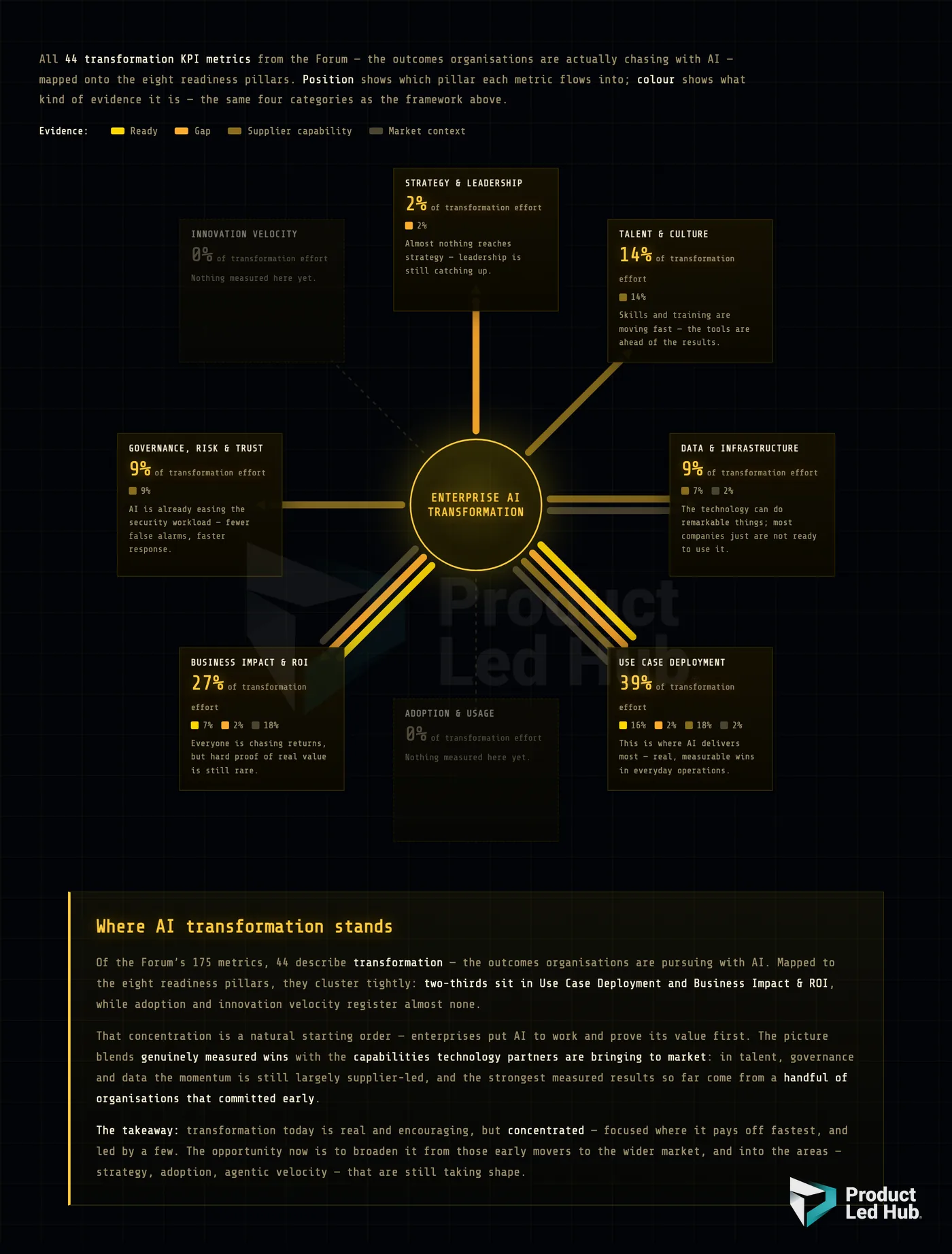
All 44 transformation KPI metrics from the Forum — the outcomes organisations are actually chasing with AI — mapped onto the eight readiness pillars. Position shows which pillar each metric flows into; colour shows what kind of evidence it is — the same four categories as the framework above.
Evidence: Ready Gap Supplier capability Market context
Enterprise AI Transformation
Where AI transformation stands
Of the Forum’s 175 metrics, 44 describe transformation — the outcomes organisations are pursuing with AI. Mapped to the eight readiness pillars, they cluster tightly: two-thirds sit in Use Case Deployment and Business Impact & ROI, while adoption and innovation velocity register almost none.
That concentration is a natural starting order — enterprises put AI to work and prove its value first. The picture blends genuinely measured wins with the capabilities technology partners are bringing to market: in talent, governance and data the momentum is still largely supplier-led, and the strongest measured results so far come from a handful of organisations that committed early.
The takeaway: transformation today is real and encouraging, but concentrated — focused where it pays off fastest, and led by a few. The opportunity now is to broaden it from those early movers to the wider market, and into the areas — strategy, adoption, agentic velocity — that are still taking shape.
Theme 1 of 6 · Integrating AI into Core Systems · 33%
Maturity 0–5Use Case Deployment 4.17 · Data & Infra Readiness 0.00
The cost of NOT integrating AI is the strongest ROI justification in the dataset.
The measured signal — Where AI is actually deployed, it works — Use Case Deployment scores 4.17 out of 5, the highest of any pillar. The problem is underneath: only about 1 in 5 organisations has the data, infrastructure and governance to scale it, and Data & Infra Readiness scores zero. Ambition isn’t the constraint — the foundation is.
The room’s read — The cost of NOT integrating is the backdrop that makes the case: offshore equipment failure $200K–500K/day, downtime $500K/hour, diagnostic lag 4–12 hours — and the only explicit rollout horizon anywhere: pilot 2–3mo, validation 2–4mo, fleet 6–12mo.
What it means for leaders — Fix the foundation before scaling — data readiness and governance, not more pilots. The deployment engine already delivers; what it stands on doesn’t yet.
Theme 2 of 6 · ROI-Driven AI · 21%
Maturity 0–5Business Impact & ROI 2.50
The return on AI shows up at two very different scales at once.
The measured signal — Returns are real but small-scale: the one hard case is a €4.3K deployment that returned ~€100K (>2,000% ROI) — a single illustrative result, not enterprise-wide. Business Impact & ROI scores 2.50/5.
The room’s read — The money & attention around AI: aggregate investment $235B (2024) → $300–400B (2025), per-token inference cost roughly half last year’s (improving unit economics, not an overheating market), over a dense layer of VC fund mechanics — portfolio sizes, exit targets. Almost the entire theme is market backdrop.
What it means for leaders — Lower the internal threshold before approving pilots — ROI shows up at small scale first. Don’t wait for a large enterprise-wide business case.
Theme 3 of 6 · Ethical AI & Governance · 17%
Maturity 0–5Governance, Risk & Trust 2.50
Trust and exposure management, not pure capability, is the market's dominant concern.
The measured signal — Recovery is the gap: only 17% of organisations recover from a breach in <100 days, against a rising threat (+44% cyberattacks) — a widening exposure window. One governance practice is in place — a quarterly AI-Committee cadence — giving Governance, Risk & Trust its 2.50/5.
The room’s read — The backdrop: accuracy thresholds diverge — 95%+ for narrow healthcare AI vs ~80% in general software — and EU AI Act compliance is projected at ~€10B over 10 years, about half the EU’s separate ~€20B AI-infrastructure investment plan.
What it means for leaders — Treat governance as a continuous strategic function, not a quarterly checkpoint — the exposure window between breach and recovery is where risk compounds.
Theme 4 of 6 · Hiring & Upskilling · 15%
Maturity 0–5Talent & Culture 1.67
Training volume is rising faster than perceived quality.
The measured signal — Volume is rising but quality lags: 63% of employees say training programmes need major improvement and 58% multitask during sessions (both Gaps). Europe’s talent structure is itself a gap — 3 lawyers per technical expert, the inverse of the US/China ratio. And where real in-house capacity exists, it’s concentrated in a couple of enterprise giants (NBG, Cosmote), not the market — so Talent & Culture scores just 1.67/5.
The room’s read — The backdrop: training completion is climbing — 41% (2023) → 50% (2025) of the global workforce — as L&D investment rises.
What it means for leaders — The talent-ratio imbalance is correctable through hiring policy directly — no culture-change programme required. Redesign upskilling delivery (format, relevance) before increasing budget or headcount.
Theme 5 of 6 · Reshaping Strategic Leadership · 9%
What's missing isn't interest — it's leaders willing to commit.
The measured signal — Where AI is applied to internal work, gains sit in a steady band — +21% decision-making, +15% productivity, −40% downtime. But boards spend ~80% of their time on past-performance review, not strategy (a Gap), and Strategy & Leadership scores 0.00/5. What separates results is leadership commitment and programme design — not the technology.
The room’s read — (panel colour, not measured KPIs) The Forum’s Boardroom Panel put the split at roughly 5% active adopters, 5% who’ve written AI off, and ~90% still ‘preparing’ or ‘undecided’. The jaw-dropping numbers — like 50× more movie output — surface only as one-off stories.
What it means for leaders — The real gap is attention at the top: shift board time toward future-facing strategy and supply decisive sponsorship. Interest is abundant; commitment is scarce.
This theme mixes two very different kinds of evidence — don't confuse them.
The measured signal — Real agent adoption is already here — a 40% agent-share of team composition in leading markets. The local target, at least one AI agent per development team by 2026, is a floor against that, not a stretch (a Gap). Innovation Velocity scores 0.00/5 on distinct scored KPIs; Adoption 2.00.
The room’s read — The headline speedups — 4,000×–40,000× — are narrow scientific simulations (wind-farm wake, physics models), compute-and-domain-specific. Treating them as a general productivity benchmark overstates what’s achievable in a typical process.
What it means for leaders — Engineering leadership here is ~one adoption cycle behind the leading markets — close it by embedding agents per team, and don’t benchmark against the 40,000× outliers.
The same 175 KPI metrics read through the lens of each room at the Forum.
Board Members & CEOs
The boards that commit now are pulling ahead — how long can you stay undecided?
Maturity 0–5Strategy & Leadership 0.00
The Forum's own Boardroom Panel put it starkly: ~5% of boards are active adopters, ~5% dismissive, and ~90% split between 'preparing' and 'undecided' — while boards spend ~80% of their time reviewing the past, not steering strategy. The constraint is decisive sponsorship, not interest or access.
60–70% → ~20%
have AI live in ≥1 unit vs genuinely AI-ready to scale
80 / 20
board time on past-review vs future strategy
9.5% vs ~30%
Greek adoption vs the US comparator
The shift — approving AI as a line item → sponsoring the readiness agenda and sequencing pilot → scale
What to do
Rebalance board time from 80/20 past-facing toward 50/50 future-facing — governance as a standing function, not a quarterly checkpoint.
Fund readiness (data, infra, governance) before widening adoption — only 1 in 5 are ready to scale.
Lower the approval threshold for small, well-scoped pilots.
Where it goes — The opportunity cost of slow adoption is quantifiable, not speculative — the gap to the ~30% US comparator is the board's to close.
Engineering & Technical Leaders
Your competitors already run on AI agents — how long can you afford to be behind?
Maturity 0–5Data & Infra Readiness 0.00 · Use Case Deployment 4.17
Readiness — data, infrastructure and governance — is the binding constraint: only 1 in 5 organisations are genuinely AI-ready. The cost of NOT integrating is the dataset's strongest ROI case: offshore downtime runs ~$500K/hour and diagnostic lag 4–12 hours.
2–3 / 2–4 / 6–12 mo
pilot / validation / fleet-rollout horizon (the only explicit one in the data)
2–5 → 100–1,000
agents per team, today vs within a year (projected)
40%
agent share of team composition in leading markets
−70%
manual SecOps workload via generative + agentic AI (supplier claim)
The shift — running disconnected pilots → building the readiness stack and embedding agents per team
What to do
Prioritise readiness audits (data quality, infra, governance) over launching more live initiatives.
Hit the 2026 floor — at least one AI agent per development team — treating 40% agent-share in leading markets as the trajectory.
Sequence to the explicit horizon: 2–3mo pilot → 2–4mo validation → 6–12mo fleet rollout.
Where it goes — Engineering leadership here is roughly one adoption cycle behind the reference markets — closable, but only by fixing readiness first.
Product Management · Operations Leaders
Great pilots that never scale are wasted — and the window to scale them is open now.
Maturity 0–5Use Case Deployment 4.17 · Business Impact & ROI 2.50
Where AI is deployed well, returns are large and fast — 40–95% gains recur across security, legal, industrial ops and training. But every case is a single, well-scoped deployment, not enterprise-wide transformation: strong at pilot level, unproven at full scale.
95% / −80%
false-positive cut / analyst time saved (ClearSkies SecOps)
94%
response-time cut, 6h → 20m (ops at the edge)
up to 90%
app-dev time reduction (low-code + AI)
~half
per-token inference cost vs last year — improving unit economics
The shift — shipping one-off pilots → productionizing scoped wins into repeatable, measured ROI
What to do
Scope small, fast and well-bounded — the biggest returns came from tightly-scoped deployments, not big programs.
Instrument ROI per deployment (time, cost, quality) so wins become repeatable, not anecdotal.
Move proven pilots through a validation → rollout path rather than leaving them stranded at demo.
Where it goes — Falling inference cost alongside rising investment signals improving economics — the window to scale scoped wins is opening, not closing.
Governance Leaders
Threats are climbing faster than most can recover — is your governance keeping up?
Maturity 0–5Governance, Risk & Trust 2.50
Governance is one of the Forum’s biggest concerns — 17% of KPIs. It isn’t the largest theme (Integrating AI leads at 58), but it’s where the exposure window is widening fastest. The gap between threat growth (+44% cyberattacks) and recovery capability (only 17% recover in <100 days) quantifies a widening exposure window — yet governance is often framed as a quarterly checkpoint, not a continuous function.
+44% / 17%
rise in cyberattacks vs orgs recovering in <100 days
$4.44M
average cost of a data breach (16% AI-driven)
~€10B / 10yr
projected EU AI Act compliance cost — half the EU's ~€20B AI-infrastructure plan
95% vs ~80%
accuracy thresholds: narrow healthcare AI vs general software
The shift — periodic committee review → continuous governance aligned to EU AI Act tiering
What to do
Shift governance from a quarterly checkpoint to a standing, continuous function.
Tier systems to EU AI Act risk levels and budget compliance as a real line (~€10B/10yr at EU scale).
Close the exposure window — invest in recovery capability, not just prevention (only 17% recover <100 days).
Where it goes — As autonomy rises, trust and exposure management — not raw capability — become the market's dominant concern.
Human Resources
You’re under-hiring the exact talent everyone’s fighting for — time to rebalance?
Maturity 0–5Talent & Culture 1.67
Training volume is rising faster than perceived quality: completion rose 41% (2023) → 50% (2025), yet 63% say programs need major improvement and 58% multitask during sessions. The structural signal is hiring composition: European startups run roughly the inverse of the US/China ratio of ~3 technical experts per lawyer. And where real in-house capacity exists, it’s concentrated in a few enterprise giants (NBG, Cosmote), not the market — which is why Talent readiness scores just 1.67/5.
41% → 50%
training completion, 2023 → 2025
63% / 58%
say programs need improvement / multitask during them
3 : 1 (inverted)
US/China technical-to-legal ratio vs Europe's inverse
39%
of core skills will change by 2030 (WEF)
The shift — generic AI-awareness training → rebalanced technical hiring and redesigned upskilling
What to do
Re-weight hiring toward technical build capacity relative to compliance/legal — a structural, correctable imbalance.
Redesign upskilling delivery (format, relevance, focus) before simply increasing budget or headcount.
Treat talent as a P&L constraint on scaling — reskilling, not compute, is the binding limit.
Where it goes — The talent-ratio imbalance is correctable through hiring policy alone — no culture-change program required.
Investors · VCs
Capital is flooding in while the market’s barely tapped — how long will the entry point last?
Maturity 0–5Business Impact & ROI 2.50
Capital is outpacing adoption — AI investment is growing ~10× faster than the economy ($235B → $300–400B) while Greek adoption sits at 9.5% against a ~30% US comparator. Falling per-token cost alongside rising aggregate investment signals improving unit economics, not an overheating market.
$300–400B
2025 global AI investment (up from $235B)
€60–80B
European AI investment; $60–70B to GenAI specifically
9.5% vs ~30%
Greek vs US adoption — an underpenetrated market
The shift — betting on model capability → backing readiness and technically-balanced teams
What to do
Lower the threshold for small, well-scoped bets — outsized ROI came from tiny, sharp deployments.
Diligence talent composition — favour technical-heavy teams over compliance-heavy ones.
Read this market as underpenetrated, not absent — the adoption gap is the opportunity, quantifiable not speculative.
Where it goes — Improving unit economics plus an adoption gap = a market that is early, not late — for disciplined, readiness-focused capital.
The next wave
The State of Agentic AI
Agentic AI — software that doesn’t just answer questions but actually does the work, taking action and finishing multi-step tasks on its own — is the frontier this series exists to track. It was also the least proven: only a handful of the 175 metrics touch on it, and just 7 are specifically about agents. Treat it as a sign of where things are heading, not where they are.
Maturity 0–5Innovation Velocity 0.00
40%
of a small software team is already AI agents, in leading markets
25%
of customer conversations already handled end-to-end by a bot
1 / team
the 2026 goal set here: at least one AI agent per development team
7 / 175
metrics are specifically about agents — the evidence is still thin
What’s real today — in the most advanced markets, AI agents already make up about 40% of a small software team, and a quarter of customer conversations are handled end-to-end by a bot. Locally, the ambition is set but not yet reached: one software company aims to put at least one AI agent per development team by 2026.
What’s still mostly promise — the tools claim big wins — up to 70% less manual security work, nearly half of routine analyst tasks automated — but these are supplier figures, not independently proven. And the boldest numbers — agents multiplying from a handful to hundreds per team within a year, software that rewrites its own code, billions flowing into AI-coding startups — are projections and demos, not evidence.
The honest read: the excitement is enormous, but the proof on the ground is thin — one 2026 target and a few supplier demos. That’s exactly why this is the frontier where organisations are furthest from ready, and where moving early matters most.
The verdict. The enterprise has started but isn't ready to scale: AI is live in most organisations, yet readiness — data, governance, talent — lags across the board. Scored across eight readiness pillars, the field averages just 1.61 out of 5 (an AI Delta of ~3.4 to target) — strong where AI is already deployed, near-zero on strategy, data foundations and forward capability. That gap, not access to the technology, is what the next five years turn on.
The six conclusions the plan acts on
That gap breaks down into six conclusions — and each one is what a recommendation is built to answer.
Conclusion 01 · Leadership
No one is actually steering AI
Strategy & Leadership scores 0.00 out of 5 — the lowest pillar of all. Boards spend ~80% of their time reviewing the past, and roughly 90% are still ‘preparing’ or ‘undecided’. Interest is everywhere; decisive leadership is missing.
Conclusion 02 · Readiness
Adoption has outrun readiness
60–70% run AI live, but only 1 in 5 has the data and controls to scale it past a pilot; Data & Infra Readiness scores 0.00/5. The base can’t hold what’s being built on it.
Conclusion 03 · Talent
Training without real capability
Talent & Culture scores 1.67/5. Training volume is rising (41%→50%), yet 63% say programmes need major improvement and 58% multitask through them. Genuine in-house skill sits in a handful of giants, not the market.
Conclusion 04 · Agentic
The frontier is unproven — and behind
Agentic AI is the least-measured area (Innovation Velocity 0.00/5, just 7 of 175 metrics) yet the fastest-moving. The 2026 target already trails leading markets, where agents make up ~40% of the team.
Conclusion 05 · Governance
Governance is a checkbox, not a function
Governance scores 2.50/5 and runs on a quarterly cadence. Threats climb (+44% cyberattacks) while only 17% recover in under 100 days — the exposure window widens between checks.
Conclusion 06 · Scale
Wins that never scale
Deployment is the strongest pillar (4.17/5) — but every win is a single, well-scoped pilot; large business cases stall, so nothing reaches enterprise scale.
The projection (2026 → 2030)
Where each of those six is heading — external forecasts placed against the Forum’s trajectory. These are projections, not Forum measurements, and the Forum’s own agentic evidence is thin (just 7 of 175 metrics), so read them as direction, not proof.
Leadership · by 2027
Strategy decides who survives
Gartner expects 40%+ of agentic-AI projects to be cancelled by 2027, and MIT already finds 95% of GenAI pilots deliver no measurable return. Strategy and value, not technology, separate the survivors from the shakeout.
Gartner projects 33% of enterprise software will be agentic by 2028 (from <1% in 2024); McKinsey finds only about a third of firms have scaled AI, with data quality the top blocker. Only those that fix the base get there.
The WEF expects 39% of core skills to change by 2030; Korn Ferry projects 85M roles left unfilled for lack of skills. Upskilling is the gate to everything above.
Gartner projects agentic AI will autonomously resolve 80% of common customer-service issues (−30% cost) by 2029; McKinsey reports agent use is already the fastest-rising area of AI adoption. Mainstream — for those who build the bench now.
Gartner expects 40% of CIOs to demand ‘guardian agents’ by 2028 to autonomously oversee AI; IBM finds 63% of organisations still have no AI-governance policy. A quarterly check can’t cover that surface.
Gartner projects 15% of day-to-day work decisions made autonomously by 2028; MIT warns most pilots never leave the lab (only 5% reach real scale). Autonomy becomes the default — pilots that never scale get left behind.
This is where the findings turn into a to-do list. Six moves — each with who owns it, roughly when, one number to watch, and how to get there. Together they close the readiness gap the report measures.
01
Build the next generation of AI leaders
The scarcest thing in the data isn’t technology — it’s leadership. Strategy & Leadership scores 0.00 out of 5, the lowest of every pillar: boards spend ~80% of their time reviewing the past, and roughly 90% are still ‘preparing’ or ‘undecided’ on AI. What’s missing isn’t interest — it’s leaders who can actually set and own an AI strategy. Build that at the top first; every other move here depends on it.
Owner: the CEO, board and C-suite.
When: now — this planning cycle.
Metric: share of senior leaders who can define and own an AI strategy, not just approve it.
How: don’t leave your leaders to work AI out on the job — put your board and C-suite through PLH’s Gen AI Executive Leadership Programme certificate, so they can actually set and own the AI strategy, not just approve the budget.
02
Fix the groundwork before adding more AI
Most companies (60–70%) already use AI somewhere, but only 1 in 5 have the data and controls to run it properly. Adding more AI projects won’t help until that groundwork is fixed first.
Owner: the CTO and data team.
When: next 3–6 months.
Metric: how many live AI projects pass a basic data-and-governance readiness check.
How: get every team to one baseline fast — GenAI Foundations for the fundamentals, GenAI Architecture for the people building the data-and-infra layer it all runs on.
03
Make upskilling actually work — build real AI capability
AI readiness isn’t held back by the tools — it’s held back by people. Talent & Culture scores just 1.67 out of 5, and the gap is quality, not effort: training is rising (completion up from 41% in 2023 to 50% in 2025), yet 63% of employees say the programmes need major improvement and 58% multitask through them. Where genuine in-house AI capability exists, it sits inside a handful of enterprise giants, not the wider market. More of the same training won’t close this — role-specific upskilling that people actually apply will.
Owner: HR & Talent with the function leads.
When: the next two training cycles.
Metric: not hours delivered, but the share of teams with hands-on AI skills they actually use.
How: swap one-size-fits-all training for certificates people actually apply — GenAI Foundations to lift the whole org, Gen AI Product Management to turn product teams into shippers.
04
Build a dedicated agentic-AI programme
Agentic AI (AI that acts on its own, not just answers) is the least-proven area today but the fastest-growing. The 2026 goal — at least one AI agent per development team — is already behind leading markets, where agents make up ~40% of the team. Set up a dedicated skills-and-leadership programme now, before the gap widens.
Owner: engineering leadership with HR.
When: stand it up in 2026.
Metric: how many agents are actually embedded per development team, against that target.
Make governance a standing job, not a quarterly check
Right now AI governance is a box ticked once a quarter, and boards spend most of their time looking backwards. Make it an ongoing job instead.
Owner: Governance, Risk & Legal with the board.
When: this planning cycle.
Metric: move the AI committee from quarterly to always-on, and shift board time toward the future (from ~20% to 50%).
How: stand up a standing AI committee with a fixed monthly cadence and a clear owner.
06
Approve small, focused pilots faster
Where AI is actually switched on it works — the report’s strongest score (4.17/5) — but only as small, single-use pilots; big all-at-once business cases stall. So make small pilots easy to approve.
Owner: Product & Transformation leads.
When: now — the next approval round.
Metric: how small your approved pilots are, and how fast they show a first result.
How: adopt a one-page approval rubric that rewards small scope and a fast first result.
The bottom line
Do these six and the readiness score — a low 1.61 out of 5 today — starts to move: a fast start on weak foundations becomes something that lasts through 2026–2030. The gap is the plan.